In depth · club history
Carnoustie Golf Links
Golf is recorded in Carnoustie in 1560. The links went on to shape the Open and send its professionals across the Atlantic.
By the ULTIMATE Golf Editorial Team
Four centuries of gowff
Carnoustie has played golf for well over four centuries. The first sign comes in the parish records of 1560, which mention the game of “gowff”, and the club’s own history suggests that a local landowner, Sir Robert Maule, may have been among the first to play. By 1839 the Carnoustie Golf Club had been formed, which the links describes as the oldest artisan club in the world.
The land belonged to the 14th Earl of Dalhousie, who in 1890 sold the links to the local authority. It had no funds to buy it, so money was raised by public subscription and given to the council.
Robertson, Morris and Braid
The original course had ten holes, crossing and recrossing the Barry Burn. It was laid out by Allan Robertson, the first golf professional, with help from Old Tom Morris, and opened in 1842. When the railway from Dundee to Arbroath opened in 1838, golfers arrived from as far as Edinburgh.
In 1867 Old Tom Morris extended the links to 18 holes, by then the standard. But it was in 1926 that James Braid was brought in for sweeping changes, and the course became ready for the Open. The Championship Course kept that routing when it was modified again before the 1999 Open.
The Open at Carnoustie
The Open came to Carnoustie in 1931, and Tommy Armour of Edinburgh won it. Henry Cotton followed in 1937, then Ben Hogan in 1953, Gary Player in 1968 and Tom Watson in 1975. The links has hosted the Open eight times in all, and will do so for a ninth time in 2029.
Few finishes are remembered like 1999. Jean van de Velde needed only a double-bogey six on the 72nd hole to win and took a seven; Paul Lawrie won the playoff. In 2007 Pádraig Harrington beat Sergio García in a four-hole playoff, and in 2018 Francesco Molinari, with a bogey-free 69, became the first Italian major winner. The course is nicknamed “Car-nasty” in North America, a nod to its difficulty in bad weather.
Exporting the game
The club’s story is also one of emigration. At the start of the 20th century around 300 of Carnoustie’s sons left, many for America, spreading the game as they went. Stewart Maiden, who taught Bobby Jones, came from here. The Smith brothers, Willie, Alex and Macdonald, were its most successful exports; in 1899 Willie became the first Carnoustie man to win the US Open, at Baltimore.
The Women’s British Open has been played here too, in 2011 and 2021, and the Senior Open in 2010 and 2016.
Beyond the Championship Course
The Amateur Championship first came to Carnoustie in 1947, won by Willie Turnesa, and the links is one of three courses that host the Alfred Dunhill Links Championship, with the Old Course at St Andrews and Kingsbarns. Two more courses have been added to the Championship Course: the Burnside and the shorter Buddon Links.
The name probably comes from two Scandinavian words, car, meaning rock, and noust, meaning bay. Carnoustie became a burgh in 1899, and in 1927 an annual amateur tournament began, which became known as the Craw’s Nest Tassie. A tassie is an old Scots word for a drinking cup.
Visiting
The links passed to the local authority in 1890 and has a large hotel behind the 18th green. The Barry Burn on the 18th is the water that shaped the 1999 and 2007 finishes.
Our advice: walk to the closing hole and stand by the Barry Burn. Knowing what happened there in 1999 and 2007 changes how you see the 18th.
Play it: Carnoustie Golf Links: the course, visitors and how to book →
Heritage nearby: The R&A World Golf Museum, Heritage of Golf Museum, Gullane
Sources
- Carnoustie Golf Links: Heritage
- Carnoustie Golf Links: The Open Championship
- Wikipedia: Carnoustie Golf Links
Checked 2026-11-14. Every fact here comes from a source above; where sources disagree on a date or a name, we leave it out.
More club histories
All histories →
Real Club Valderrama
A Robert Trent Jones Sr course on the Andalusian coast that was rebuilt in the 1980s and became the setting for Europe’s 1997 Ryder Cup.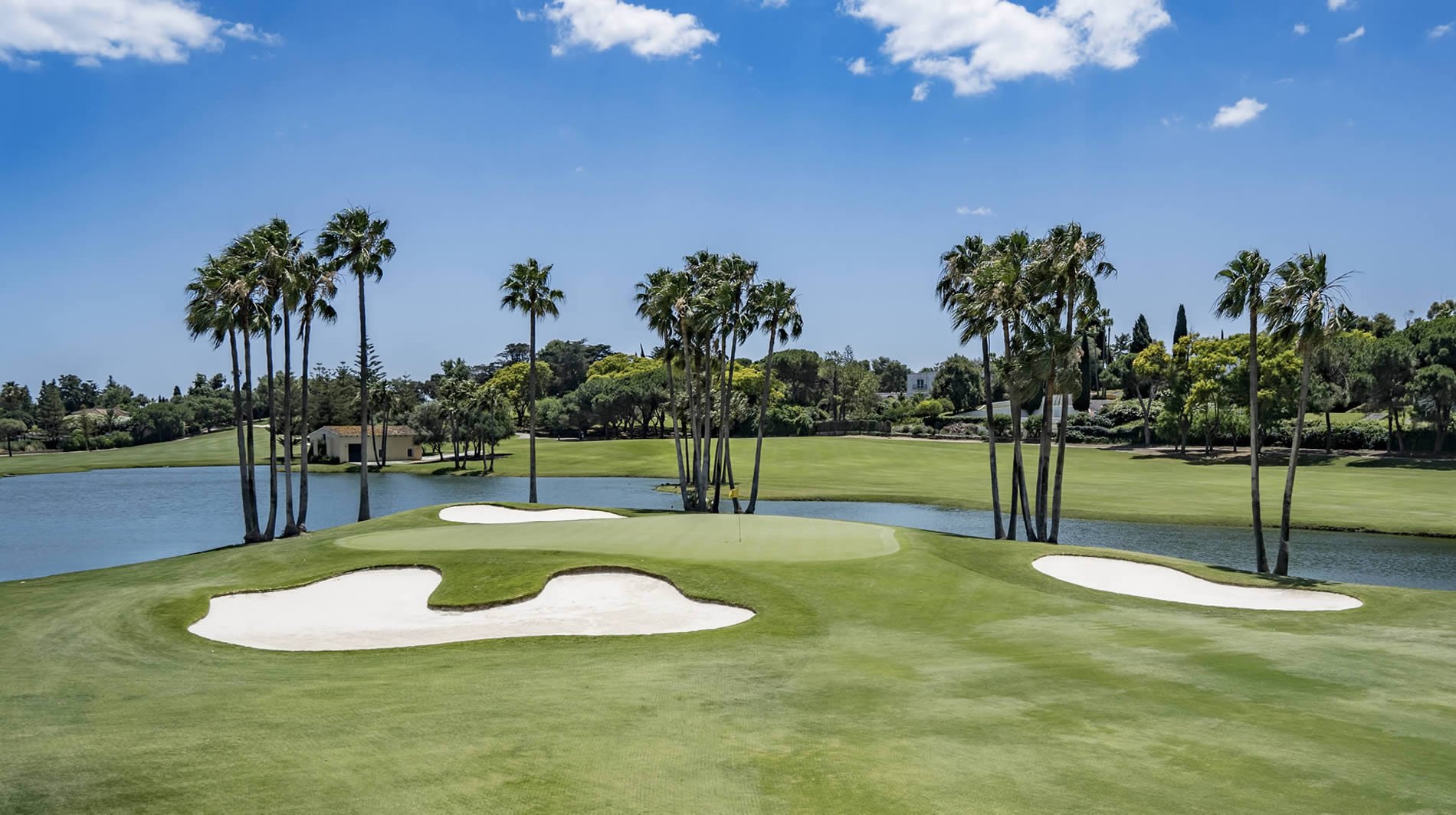
Real Club de Golf Sotogrande
Opened in 1964 as the heart of a new residential estate, Sotogrande was Robert Trent Jones’s first European course.