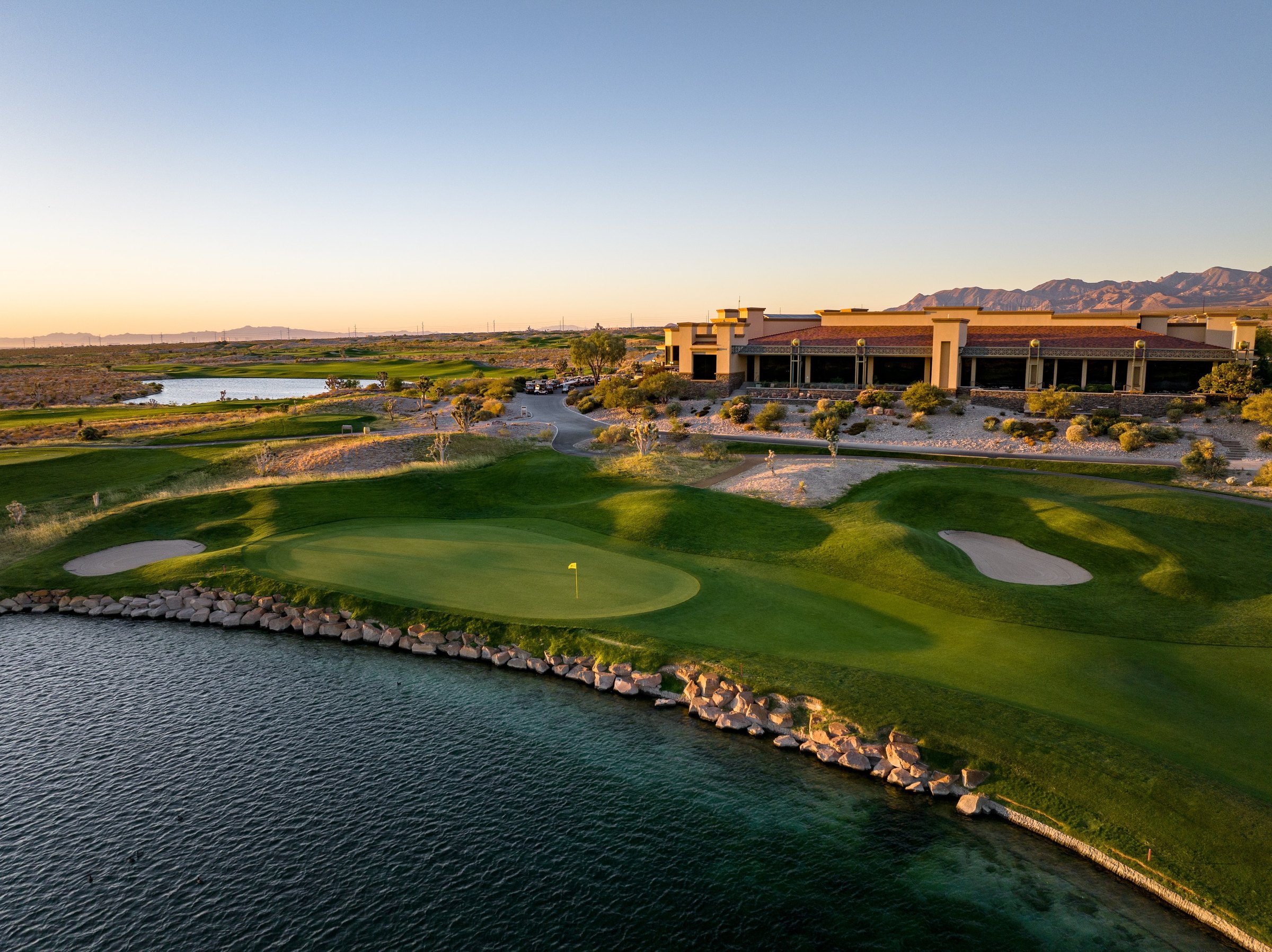
Photo credit
Image courtesy of © Las Vegas Paiute Golf ResortIn depth · course architect
Pete Dye: railroad ties and pot bunkers
An Ohio-born insurance salesman who turned to design in his mid-30s and became one of the most influential course architects in the world; his three Las Vegas Paiute layouts are on ULTIMATE Golf.
By the ULTIMATE Golf Editorial Team
Who he was
Paul Dye Jr., known as Pete, was born on 29 December 1925 in Urbana, Ohio. His father had built a nine-hole course on family land, and as a youngster Pete worked and played there. At Urbana High School he won the Ohio state high school golf championship. He entered the US Army at 18, in 1944, and served at Fort Bragg as greenskeeper on the base course.
At Pinehurst he played No. 2 for six solid months and got to know Donald Ross, who had built the Fort Bragg course. After the army he studied at Rollins College in Florida, where he met Alice O’Neal. They married in early 1950 and Alice, a fellow amateur champion, became his partner in design.
How he came to design
In the early 1950s the couple moved to Indianapolis, where Dye sold insurance and, within a few years, became a million-dollar salesman. He also won the Indiana amateur championship in 1958 and qualified for the 1957 U.S. Open.
Dye decided to become a course designer in his mid-30s. In 1961 the couple visited the architect Bill Diddle, who warned them about the profession’s uncertainty; they persisted. Their first design was the nine-hole El Dorado south of Indianapolis, whose creek was crossed thirteen times, and in 1962 came their first 18-hole course, Heather Hills.
His design ideas
A trip to Scotland in 1963 changed his style. Until then he had been using the approach of Trent Jones; the Scottish courses showed him pot bunkers, wooden bulkheads and tiny greens. Crooked Stick in Indiana, begun in 1964, was his first well-known course.
His signatures are small greens, deep bunkers held by railroad ties, and short, challenging par fours, credited with returning that kind of hole to the game. At the Stadium Course at TPC Sawgrass, the par-3 17th with its island green gained wide notice at the first Players Championship in 1982.
In 1967, designing The Golf Club near Columbus, Ohio, he sought input from the 27-year-old Jack Nicklaus. The two went on to design Harbour Town Golf Links in South Carolina, opened in 1969. Nicklaus credits Dye with significant influence on his own approach.
On ULTIMATE Golf
Las Vegas Paiute Golf Resort lies about 25 minutes northwest of the Las Vegas Strip and offers three Dye layouts: Snow Mountain, Sun Mountain and The Wolf. The resort’s own phrase is that “One-of-a-Kind can now come in Threes.”
Snow Mountain, the original course, has wide rye grass fairways, seven holes with water, traditional Dye railroad-tie bunkers, dogleg finishing holes and a progressive layout; it measures 7,164 total yards. The resort also describes Dye as a World Golf Hall of Fame inductee and Lifetime Achievement award recipient.
Honours came late and often: the Donald Ross Award from the American Society of Golf Course Architects in 1995, the Old Tom Morris Award in 2003, the PGA Distinguished Service Award in 2004 and the PGA Tour Lifetime Achievement Award in 2005. He entered the World Golf Hall of Fame in 2008 and was awarded a Doctor of Landscape Architecture degree by Purdue University.
Dye died on 9 January 2020. He is credited with more than 200 courses, and many of the best young architects, among them Bill Coore, have “pushed dirt” for him.
Our advice: start with Snow Mountain for the clearest picture of the railroad-tie style, then compare it with the other two layouts over a second day.
The photograph shows Las Vegas Paiute Golf Resort.
Sources
Checked 2026-11-14. Every fact here comes from a source above; where sources disagree on a date or a name, we leave it out.